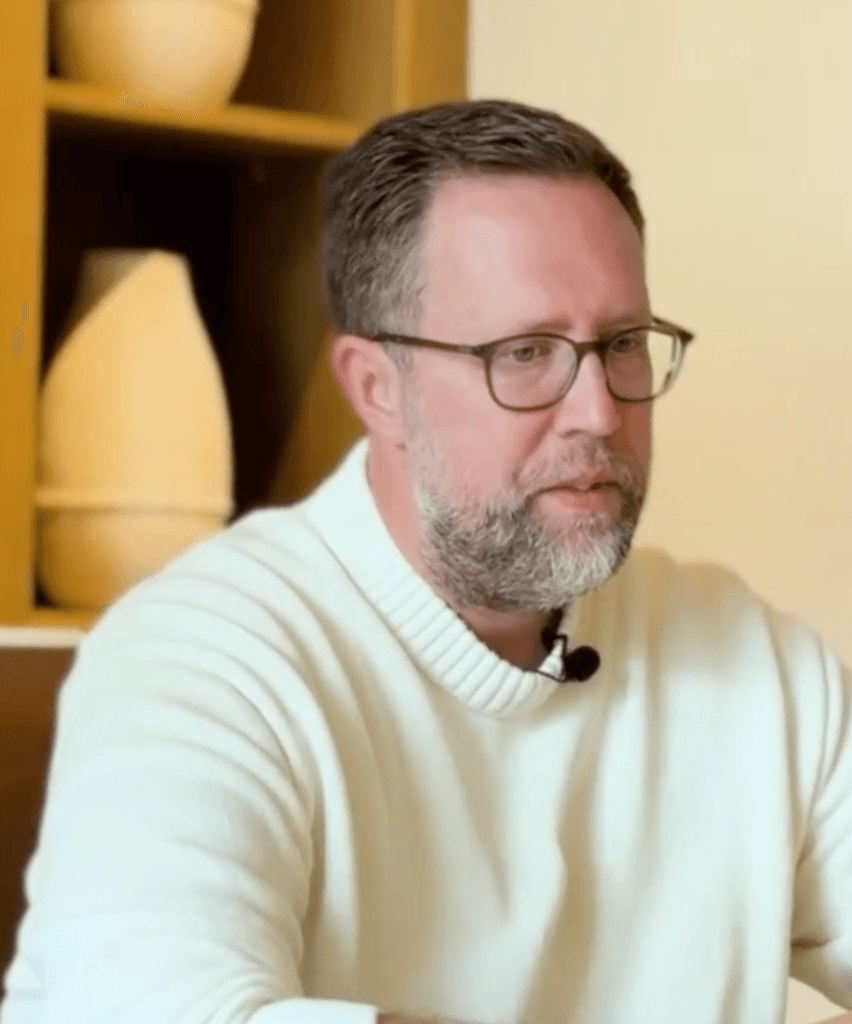
Mark, thanks for having me here at the Usual. Thanks, Jason. I have to say it's an amazing property. So we've stayed here for the last two nights and we slept well. Felt extremely welcome. I'm so glad! And uh, the location's amazing. Everything is done so nicely. We had a really good time exploring all of the products in the room, especially like the, the materials used for the ceramic substitutes. Yeah. Which was really cool to see that this was actually possible. Our wooden toilets.
Yeah, you, the wooden toilets. It's exactly, they were very fascinating that they didn't feel wooden, in a way, shape, or form. And I suppose all the information about all the materials used would be on your website. Uh, a lot of it's on our website and we have also some information, some documents that are specifically about the materials. Yeah. There's also a, a newspaper that, uh, we've brought out, it's, I don't know if it's in the room right now, but "the good paper", which contains a lot
of the information on the materials, but basically everything you see in the hotel has been thought about. Is either made of recycled materials or, or sustainable materials. Yeah. Yeah. And the amazing thing is it feels like a premium product. Yeah. Get a good sense that the hotel is trying very hard, but I don't want to go into that. This is, I think people can find more information on your website. Definitely. I want to talk about the tech angle with the Usual, because you've also done
something unusual with your tech, which is you built everything from scratch and you didn't one of us fragmented, we didn't wanna piece together hospitality systems. Uh, so can you tell us a little bit about the idea that went into that process where you initially set up the company? Yeah. And how did you approach the task? Yeah, of course. So I think it's, it is very important that the people in the hotel are busy with what they do best and that's being hospitable towards guests.
And nothing frustrates me more walking into a hotel and the first thing you're being asked is. Who are you and can I have your credit card? Basically, can you afford staying here? And all that administrative task that goes into it, filling out guest registration forms, all that needs to be automated and taken away from the front desk so the people here can ask you where you wanna stay or where you wanna eat tonight and, and welcome you. Uh, basically. So that's the mission we set out to achieve, and we did that by...
like picking out the best systems that we could find at that point. So not going for an all in one solution, but picking very good companies that have a good system at their core business and then building a, a layer in the middle. It kind of connects it all. And so we can keep in control of our own data. So not that the systems are not talking like directly to the, to each other, but uh, we have a middleware layer set up. Everything connects. And then on top of that, we have our own kiosks, our own booking engine,
uh, online check-in, payments, automations, stuff like that. Yeah. And how did you approach building that? Do you get like a team of engineers and say, okay, we're gonna build this booking engine now, let's get it done. Uh, well, yeah, basically, but I have a software. Uh, engineering background. I have had a software company for like 15 years and then I kind of rolled into hospitality. We did EasyHotel before this, and then we started this new company, which actually has a purpose.
So a lot of people that came from EasyHotel came to the usual to make something beautiful. Uh, and I have a team of, of software engineers that's that set out to do this. Yeah. And how big was that team? Uh, three people. Okay. Yeah. Yeah, we try to be very lean. Okay. Not very big. But yes, it's amazing. So what, what are the roles of everyone? So you have like a designer, backend and front end. Yeah. Would that be how you.. No, we've both also worked for some freelancers. So for, especially for the front end stuff, uh, we work with freelancers.
We have two senior programmers and full stack. They just do everything, have full stack. Okay. We have a support, a guy who takes care of the support in the hotels, but also there we try to. Really limit the amount of stuff we have from the hotel. So we have no server, basically everything's in the cloud. Everything is remotely managed. Everything can be done remotely, basically. And how long did it take you from the point you said, I'm gonna build this to actually delivering that?
Like you built your own kiosk. That's, yeah. Pretty remarkable. Yeah. And like, just to put that in context, it can scan a QR code, it can cut keys. Yeah. Uh, it's kind of a touch screen in there. And it also integrates with the PMS because I requested one of the team members for an extra key and they did something on their computer and the key, like was cut on one of the kiosks. So that's quite a lot of functionality in there. How, how did you get that done? Yeah, we looked at the standard kiosk solutions, of course, but here the
idea again was, uh, I personally think that we'll be moving away from kiosks. Okay. Everyone has their own little kiosk in there pocket at this, uh, at this point. So it didn't make sense to, maybe it's a little bit too early, but it didn't make sense to make a full blown kiosk where people will type out their information and then that all has to be done upfront. Yeah. Think of the kiosk more as a key retrieval station. So you, you fill out all your details beforehand, you scan your core code
and, and, and the kiosk cuts the key. We have the experience. We also build kiosk for easy hotel because they use the proprietary PMS and we kind of had to yeah, build our own, uh, system. But it gave us a lot of insights on what works and what doesn't work. And what you don't want is a queue for the kiosk. 'cause someone can, can't find a reservation or has trouble inputting some stuff or gets a selection of, oh, which room do you want? And then doesn't know which room is best.
And then ask the staff member. So we see a lot of bottlenecks in, in the kiosk design as well. So that's why we built kinda simplified version of, of the kiosk. Yeah. And the way you put it, it's so easy. Like everyone has a kiosk in their, in their pocket. Yeah. Which is so true if you think about it. You, yeah. Why, if, why do you need a kiosk? Why am I typing like one finger at a time on a big touch screen? Yeah. Well, in, in seconds I could do it on my phone. Exactly. So even there, we try to now move people from the kiosk to a mobile phone.
So if people come into the hotel and they haven't done a pre-check in, we can also, uh, tell the kiosk, okay. Go into. Basically a scanning mode. And it will, the kiosk will present you with a QR card that you can scan and then fill out your information. Yeah. So you can just sit down and have a coffee, maybe fill out your information on your phone where you have autofill and, and everything instead of sitting there at the kiosk. And then when you're done, the kiosk will automatically go on to the next
step, which is creating your key. Yeah. So even that step, we kind of try to take away from the queue's, gonna move to the. Move to the user's device, and of course keys will ultimately just be on the phones, right? Yes. So we're working on that as well. We are doing a pilot right now because Apple finally allows for web provisioning. Yeah. Which is kind of what we, uh, what we wanted. We didn't want an extra app that people had to download. Yeah. So now that Apple finally allows mobile, uh, wallets, keys to be published
from the web or provisioned from the website, we're doing a trial with that. That will be released, uh, this year. Yeah. Are they very expensive by the way? I don't know. Okay. Yeah. Yeah, yeah. There's a bit of mystery around Yeah, there is a bit of mystery. Yeah. Also, you need to give, uh, also your front desk, the ability to create those apple keys as well. So it's also an operational, like a, a procedural thing that you need to change. You can't just do it on the kiosk, but the front desk also needs to
be able to make these digital keys. So yeah. Yeah. We were trialing it and now like the Usual is not an automated hotel. It's like a very. Personal, local friendly, uh, kind of community oriented property. So how do you ensure that all this automation still contributes to that community? Because I'd say I do everything on my phone. Yeah. Maybe I'll just never talk to anyone. I'll just go to the room and like kind of alone. Well if, if you want that, that's, that's an option. If you want to come in and do it yourself and go to your room, that's fine.
Yeah. But there's a lot of people that do want to talk to someone, and I don't want that someone to be busy filling out forms or checking passports. So that's the part that we take away. So when you do come in, you can just quickly create your key and then go to someone who said, Hey. Do you want a coffee? What do you wanna talk about? Basically make, make the people available for that, for like true hospitality. So that's the philosophy behind it. Yeah. And because the kiosk does provide like this meeting point, right?
Like you just kind of walk to the kiosk? Yeah. And there's someone looking, standing next to the kiosk and they're like, Hey, what can I do for you? Yeah. So if, if you want that personal interaction mm-hmm. People are there for you. Yeah, definitely. Right. And we try to, we have other systems. We work a lot with bookboost. Uh, we, we try to basically condense as many communications channels into one because we have email, WhatsApp, SMS all coming in and we don't want people to check booking Extranet and Expedia and five different channels.
So we try to condense that so that people are very focused, on one channel and provide good service there. And then the rest of the time they can just go around not being on their laptop and talk. And are people like replying to messages, like with this unified inbox from Book Boost? Are they replying to it here on the property or do you have a central team that We are, we have one or two people here, guest relations. Okay. Uh, which also reply, but the team also does it when they're not here.
Okay. Yeah. And our AI bot helps a lot. Yeah. So, so I have what you say, have you heard. Yeah, I tried messing around with it. Yeah, I tried messing around with it last night and then when a human stepped in and they were like, Hey, can I help you? And I was, oh, okay. No, sorry. Just, just being annoying because, because I need someone to talk to. I'm trying to see if I can brake the bot idea that that's what I was trying to do. But, so I was trying to understand who's replying to it, where are they right now?
Yeah. Uh, et cetera, et cetera. So can you like, tell me about your AI plans, like what's gonna happen there on the AI front? Because when we spoke, uh, the first time you mentioned something about it building AI agents and that really like, uh, picked my curiosity. Yeah. I think AI is gonna change hospitality a lot or it's already changed the hospitality a lot. In the beginning. Like a year ago I was kind of skeptical because, uh, we did some pilots with, uh, generative AI. We put all our document into an vector database and then.
It's, it's very nice to have a chat interface and you can ask what kind of materials are in the lobby and you get a list from the AI but that was kind of the use case that we had, and that was it. But with age Agentic AI, that's something different right now. An AI can actually go out there and do stuff for you, and that's what makes it different. And, and I see a lot of applications there. So we were trialing some, some stuff. Of course, the, the AI agent that connected to bookboost
is, is, is really awesome. It's, it's been selling, uh, upselling breakfast, for example, really well. But we're also trying to get rid of more administrative tasks. Think about, uh, commission, uh, invoice checking for example, or very simple agent that we made is, uh, one that kind of does a checklist for the front desk at the beginning of the day. Mm-hmm. Very simple. But very useful that you don't have to go through all the reservations. Who put what in the comments? Oh, this person would like a room next to the elevator.
Oh, no. It's just as simple. The AI check agent checks, all the reservations, makes a short list. Okay, this person needs a tote bag and a water bottle in the room. These people still need to pay. That's it. Yeah. Can you walk me through how you got there? How we got there? Eh? Okay. That start at the beginning because I talked about this middleware layer that we've built. Yeah. When we started that, it was more about, okay, we don't want all these different systems talking to each other because we kind of step, try to step away from a
monolithic system because it's very hard to, if you say, okay, my communication platform is not working correctly. I need to find a different one. If you have a monolith, then you can't move away or you need to move everything. So we try to move to more, more like a composable. Business model, however, that comes with its own, uh, challenges because if everything is interconnected and everyone is talking to each other, then you still have a monolith, just a monolith consisting of lots of different parts.
So we have this middleware layered where all these components talk to took this layer and they have a central database that stores all the reservation and guest data. And you built that. We built that, we built that. We focused on that a lot and that has really benefited us right now. Because on top of that middleware layer, we can just easily now say, okay, we already have this API. We've just, we can talk to payment system, can we create payment link, can retrieve reservations, can create tickets in the in housekeeping system, et cetera.
Let's just add an MCP server next to it. Yeah. That talks to this API. And all of a sudden you can very easily build an agent that talks to an MCP server that does a whole bunch, a range of stuff, has lots of tools. So that's what we've been doing. We first built a, a usual MCP server and then trialed with different. Agent we use n8n. Yeah. We've also been using Symantec Kernel by Microsoft. Yeah. That, that's, that's where we are right now. It's still in the, in the, in the startup phase.
Because, I'm a strong believer of starting small, measuring how valuable it actually is, and then scaling up. Yeah. So that's where we we're right now. So how does reception get this report? Is it Email? Them like a PDF, not just a plain text in the you to say, here's what's going on today. Yeah. And what's been their feedback so far? Yeah, pretty good. Yeah. Yeah, yeah. Yeah. It's, and it is just a time saver. Yeah. Not having to go through all that, all those reservations. Amazing.
Anything to make their life easier. Yes, we try to do now. And do you worry about security? We are constantly worrying about security. I think AI agents in general have a lot of security issues that need to be flushed out. Authentication is not really, it's kind of mess still. And I worry a little bit about how easy it is to build an AI agent right now, anyone can have access to n8n, and just connect a whole bunch of things and all of them. So your guest data is in 18 different systems and all over the place.
So yeah, we're constantly thinking about how can we make it secure? Uh, how can we obfuscate, uh, like our MCP server. Does not give out like personal information. Yeah. Yeah. So reservation numbers is what we're working with. Or if someone changes some information as well. Yeah. Well, should not be touching them. What your MCP server servers can do is, is something that needs to be very restricted. Yeah, yeah. Which agent can do what on your MCP server? Yeah. And what, what's been the, the staff reaction to like more tech coming in?
How do you, how do you handle that? Um, very positive, especially the agent, the, our chat agent. Extremely positive. If you like, we, like I said, we are not doing it to reduce staff. Yeah. We're just, we are using it to free them up for more important tasks. If you, if you bring it to them like this as well, they're very receptive to it. They don't wanna be on their laptop. That's not why they went into hospitality. Yeah. So, yeah, no, very positive. Yeah. And, and guests also in general feedback to our a like the, the, the, how they
rate the agent super high, right? Yeah. Yeah. So, no, I, I see a lot of positive things about AI. It's a lot of. Things we need to work out with AI. Yeah. But yeah, no, this, this part is really positive. Yeah. And I just wanna change a little bit from like tech for guest experience to a little bit of tech for sustainability, because that way we started off our conversation. And do you have any tech initiatives right now that you are kind of using to push forward your sustainability mission?
How, how do you think about that? Yeah. Well I think tech is really important for your sustainability mission. Sustainability is really at the core of our, of our business, basically. So from pre-construction to operation, we try to be as sustainable as possible and you can be sustainable without using tech to, for example, measure. Mm-hmm. Like measuring your impact and being transparent are one of the most important thing. If you wanna be a sustainable brand, there are lots of brands that are kinda.
Running on good, good vibes and, and feelings. That's not what we're about. We, we want to be concrete in our, this is what we're doing, this is what the impact. This is where we can improve. So we work with a company that that measures a lot of stuff, collects it in one big system and we try to report very accurately on this. So because you even report like the impact of every single guest stay, right? Like you down to that level long management? No, we try, we will eventually.
Okay, okay. Okay. We're trying to get there. Yeah. Right. But I think being transparent is one of the major things, which is why we're already doing the CSRD reporting right now, which is a huge amount of work. Yeah. And even though we, I technically think we don't have to, but we want to because we wanna be transparent. Yeah. Um, and technology is very important for that. But also technology or our sustainability is not just, oh, we're gonna offset our carbon footprint, or we're gonna plant some trees, or like that.
It's also about social sustainability. So, and we also look for partners who work sustainably. So for example, our network partner Wentzo, um, very good guys and they focus heavily on educating, uh, people. One of the projects they work with is, is called DEAN Digital Education, Africa Network, I think, something like that. So they go to Africa, take home the old network, uh, take their old network equipment that come from their customers and use it to educate technicians there.
In their home country, how to build a network, how to maintain it and use it in schools and universities. Yeah. But to go a little deeper into that measurement side of things, uh, how do you think about it? Like, are you looking at. IOT solutions and stuff like that to get into the room, to canal it even further, or what do you think is the biggest impact from an individual guest stay that you are looking to control or measure and improve. So we're still investigating IOT because it's very easy to
just put sensors everywhere. Yeah. But what are you doing with that enormous amount of data that those sensors generate? Does it have any benefit? Are we actually like steering, uh, on that? What I don't want is, uh, a sensor that measures how long a guest showers. When a guest comes here, they should feel like, oh, sustainability part taken care of by "The Usual "That's what I wanna focus on. Yeah. Um. Not make the guests feel guilty for wanting a new towel. Yeah, so I'm I am focused on, on how we can optimize energy usage in the
room when the guest is not there. Uh, so putting more sensors, maybe shades that go down or, or robotic robotic app basically, or, uh. AC turns off automatically when it detects, no one is in the room. We're working on that. It's not in this hotel yet, but we're working on it in, in our new property in Florence. So we'll see how that, how that goes. Um, most important is that it is reliable, maintainable, low maintenance. Um, that's, that's the most important thing. Yeah. Um, yeah.
Look at various companies who can, who can do that. We haven't made the decision yet. Uh, I, I just wanna go a little further. So you, we spoke a little bit about IOT. Yeah. I also saw like a cleaning robot, out in the corridor. So is that also featuring in your, uh, thought process? How are you thinking about that? A clean robot just makes sense. This is a very large space. Yeah. Yeah. In order to keep it clean, we just need someone to kind of clean practical stuff. Yeah, yeah.
But does that fall under your purview as a, this is more the housekeeping company, I'll be honest. Yeah. Okay. So you wouldn't get involved too in that, in those decisions? No. If they think this is the best way to keep the space clean and tidy, let's, let's go for it. Yeah. Yeah. Amazing. And so just to go back to your role as like. CTO of this company, how do we see that role evolving as we progress down this path? You know, because technology is moving so fast, uh, many brands are even just
kind of calling themselves technology companies in the hospitality industry. Uh, and you would be very close to that, to me, to be honest, because you've just got such a. Huge role of technology in your company. So have you seen your role progressing? Yeah. Honestly, I think hotels should be focusing more on technology. I've been in this industry for, I dunno, uh, since 2011 or or 2010 now, and we're a little bit old fashioned still, but it was not old fashioned. This, for example, booking.com or an Expedia or, or you see this, this new.
Wave of technology coming with AI agents and the first thing I see is booking immediately moving into that space and, and saying, Hey, we're gonna take a big chunk of that because. Google searches are down. We're partnering with chat GPT People are changing the way they're booking travel. Well, that's, that's gonna go to Booking. And Expedia, Expedia's partnering with Perplexity. Do you think they're gonna win? Um, I think they have a good chance to be honest. Yeah. Yeah. They definitely have a good chance.
I definitely think the way people are booking travel is, is rapidly changing and the abil and with AI agents proactively going out there and doing stuff for you. I don't see it as unreasonable as. Someone's saying, I want a trip to Barcelona for five days. These are the things that are important to me. Please arrange it. And an AI agent goes out there and books the hotels for you. If your hotel is not ready and you still have your PMS running in a, in a basement on a physical server.
Yeah, there's no way an agent is gonna find you or gonna book you. Uh, now is the time to upgrade your technology stack and go to some ready for that, ready for that. The people are, things are changing and I think Booking is very, doing very well in, in jumping into that gap and seeing that opportunity and, and getting ready for that. So yeah, it doesn't seem unreasonable that that traffic is gonna go to booking. Yeah. I will hoped, we would've had a chance to like, yeah, yeah.
Intercept it. Is there something you're doing on a. Daily, weekly, monthly basis to kind of prepare for this change. How are you keeping abreast of all of these changes? Because, yeah, that's very difficult because it's going so fast, but I think it's very important, for example, to get your websites ready with markup language that an AI can read. There's this whole ecosystem that's kind of growing. That's, that's focused on in AI and, and connectability. It's been going on for a while now.
PMS is that focus on, Hey, we have an open API, you can connect to us, you can do things, uh, very easily. It's not behind some, some kind of certification process. There's a whole ecosystem of parties that are joining that you need to be adopting that. Because an AI will want that. Yeah. I want to connect to PMS. I wanna book a room directly, uh, if there's a financial benefit to it, for example. So yeah, I try to keep up to date. With that. I'm very interested to see how this, uh, agent to agent protocol is gonna
play out that Google is developing, uh, and it's being supported by Microsoft. Yeah. The future where agents talk to each other and maybe you have your hotel agent that kind of handles all the, all internal stuff, and you have a agent that a guest is running that is trying to book a room. Yeah. That's, I think that's coming. Yeah. So that was too early for that still, but. It's coming. Soon. It is coming. And not years. This is not years away because they're saying by the end of the year chat, GPT will have a billion users.
Yeah. And that's one out of every five adults on this world is gonna use such insane, yeah. So if they're starting their travel search on chat, GPT. Like, how did they end up at the hotel? Exactly. And do you do that sometimes? Do you just like go and ask for, get a rot? I, don't necessarily do that yet. Maybe I'm too old. No, I, but no, not just to see are you ranking and if you're showing off. So our, our article marketing manager is very much busy with this. It's also making a website ready for, for AI and making sure that we.
Can be found. If someone wants a sustainable stay in the Netherlands, we need to be out there basically. And she's very much busy with that. Amazing. No, it's all, it's all very fascinating. It seems like you guys are right on the ball when it comes to all of these facets. We're trying to what? What can we expect next from the usual show. Well, we're opening a hotel insurance, which is very excited about, we hope to grow. We wanna open about 20 hotels in the next few years. We'll see if that, uh, if we make it there.
But that's, yeah, we really wanna be the most sustainable hotel company in Europe. We're trying really hard. Though. I can see that. And we've had a wonderful stay, uh, at I can see all of the hard work that's gone into it. And thanks again for making some time to talk to us. You're very welcome, Jason.